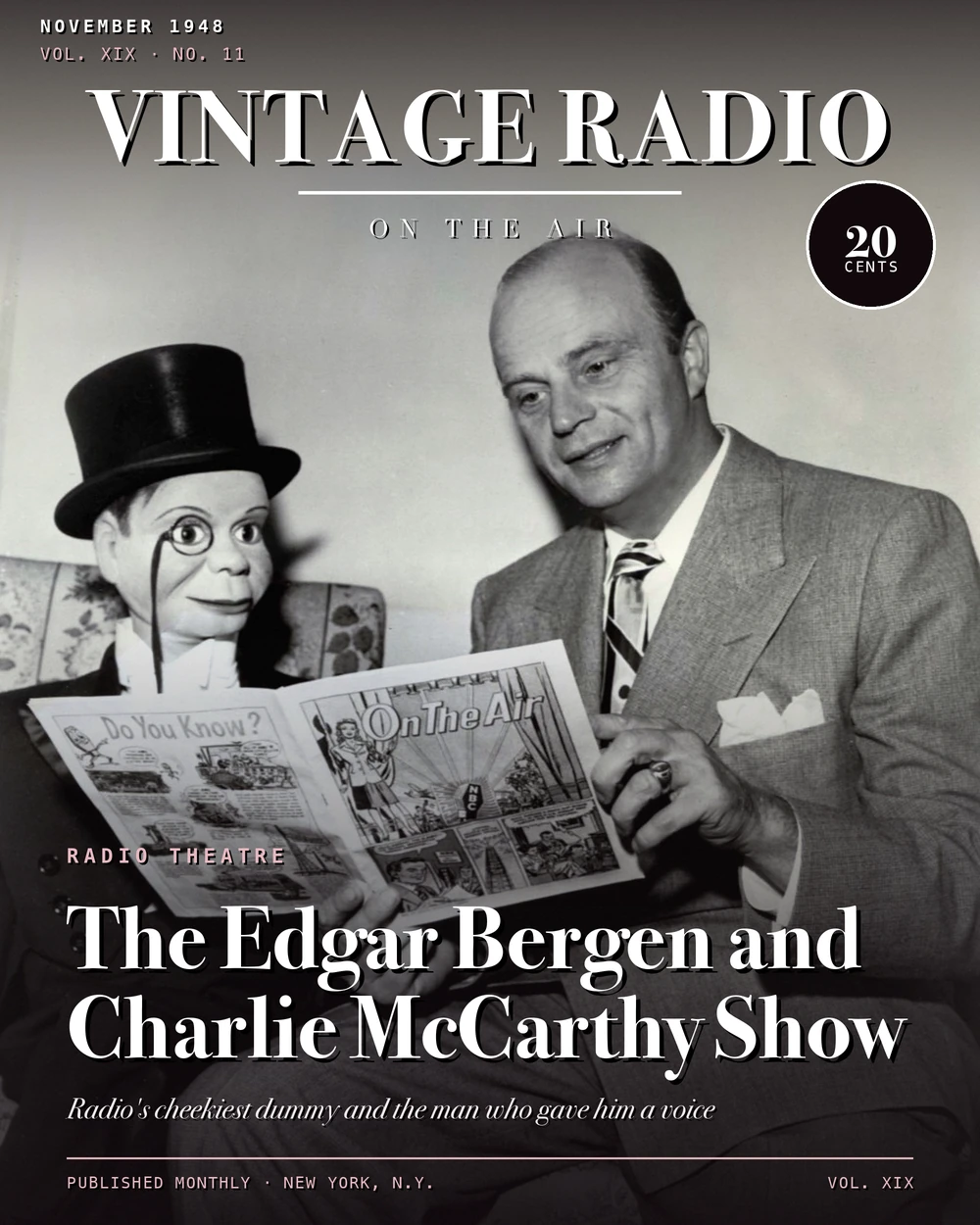
The Edgar Bergen & Charlie McCarthy Show
A Ventriloquist on Radio
The most persistent joke about Edgar Bergen's career is that he chose the one medium where nobody could see his lips move. John Reber of J. Walter Thompson, the agency handling Rudy Vallee's show, reportedly said Bergen had better be funny if he hoped to overcome the limitations of a ventriloquist performing on radio. Bergen overcame them so thoroughly that his program spent most of its first three seasons as the top-rated show on all of American radio, and remained in the top seven continuously for fifteen years.
Bergen had spent nearly fifteen years in vaudeville and nightclubs before Vallee caught his act at an Elsa Maxwell party and invited him on. The premiere, on December 17, 1936, had Vallee introducing Bergen with something close to an apology, acknowledging the oddity of the situation. Bergen's dummy introduced himself as "Bemby," spoke in a clipped upper-class British accent, and only reluctantly admitted his name was Charlie McCarthy. The bit involved a crystal ball, a whirlpool, and a cesspool, and it worked on rapid-fire questions, short answers, and constant voice-switching. Vallee signed Bergen for thirteen more weeks on the spot.
The reason it worked on radio — the reason it worked at all — came down to characterization. Charlie McCarthy, dressed in a top hat, tailcoat, and monocle, was a brash and wisecracking small boy who mocked Bergen's receding hairline, reminded him regularly that he'd be nothing without Charlie, and sailed through every routine without ever fluffing a line. Bergen, meanwhile, played the exasperated moralistic father figure, stern and lecturing. That dynamic required no visual; it was pure voice and personality. Don Ameche, who co-starred in the early years, called Bergen one of the cleverest comic ad-libbers in radio. The odd detail is that Bergen himself often stumbled on lines. Charlie never did.
How Bergen Got Here
Edgar Bergen was born in Chicago on February 16, 1903, to Swedish immigrants — Johan Henriksson Berggren and Nilla Svensdotter, née Osberg — who had settled in the American Midwest and taken up dairy farming. He was one of five children, the younger of two sons. When his father died and Bergen was sixteen, he worked as an apprentice accountant, a furnace stoker, a player-piano operator, and a projectionist in a silent-movie house before ventriloquism took over.
His interest had started at eleven, when he sent away for a book called The Wizard's Manual and discovered he could produce what he called "belly talk" — forcing the voice up from the abdomen through the larynx so it sounded distant and thrown. When the noted ventriloquist Harry Lester played Chicago, Bergen went to see him. Lester was impressed enough to give the young Bergen nearly three months of daily lessons in the fundamentals, free of charge.
Charlie McCarthy's face was modeled after a neighborhood newsboy named Charlie and carved from a block of white pine by a bartender-carpenter named Theodore Mack, who charged Bergen thirty-five dollars. The name combined the newsboy's first name, the carver's surname, and what Bergen described as an ancient Celtic suffix. Bergen built Charlie's body himself, using a nine-inch length of broomstick for the backbone, with rubber bands and cords to operate the jaw. The dummy was fully dressed in his signature top hat, tailcoat, and monocle by 1930. The original head was eventually insured for ten thousand dollars, and Bergen made provisions for Charlie in his will — including a bequest of ten thousand dollars for what Bergen called sentimental reasons, because Charlie had been his constant companion and had taken on the character of a real person from whom Bergen had never been separated even for a day.
In high school, Bergen had already figured out one key thing: he could say through his dummy what would embarrass him if he said it himself. His commentary on teachers and administrators was, by all accounts, widely appreciated. He attended Lake View High School and later enrolled at Northwestern University as a pre-med student before switching to speech and drama — earning his way by performing at parties and socials. He never finished his degree, but Northwestern eventually awarded the dummy an honorary degree in 1938, as a "master of innuendo and the snappy comeback."
The Chase and Sanborn Years
After Bergen's first season with Vallee, Standard Brands gave him his own program. The Chase and Sanborn Hour launched on NBC on May 9, 1937, airing Sundays at eight in the evening. It ran sixty minutes and carried a full supporting company: Don Ameche as announcer and straight man, Dorothy Lamour as the resident glamour, singer Nelson Eddy, and — for the first season and a half — W. C. Fields.
The verbal feud between Charlie McCarthy and W. C. Fields ran just over five months. Fields threatened to carve Charlie into a Venetian blind; Charlie replied, "That makes me shudder." Charlie's line — "Pink elephants take aspirin to get rid of W. C. Fields" — circulated nationally. "I'll mow ya down!" became a catch phrase by the fall of 1937. Fields was, by most accounts, the sharper comedian in isolation, but Bergen holding Charlie's voice more than kept pace. The feud has been called the most potent of all the great radio comedy feuds, surpassing the Jack Benny–Fred Allen rivalry, the Ben Bernie–Walter Winchell bout, and the Bing Crosby–Bob Hope exchanges.
The Hooper ratings for January through June 1938 placed Bergen and McCarthy number one among all prime-time network programs, with a Hooperating of 32.1 — the highest average of that season. A single episode from the debut season in January 1937 had scored a 41.1, the highest Hooperating ever recorded for a weekly series at the time. The show held the top spot for its first three seasons, tied with Fibber McGee and Molly in 1941–42, and ranked among radio's top seven continuously through 1952.
The most consequential broadcast of those years happened on December 12, 1937. The Mae West "Adam and Eve" sketch, written by Arch Oboler, had cleared the NBC censor without incident — the censor apparently hadn't anticipated how West would deliver the lines. The broadcast generated more than a thousand letters of protest within days. The Chicago Tribune called it "vomitous." NBC and J. Walter Thompson issued public apologies and announced they would never air anything like it again. The FCC demanded a transcription of the broadcast, copies of network contracts, and the call letters of every station that carried the show. In January 1938, FCC chairman Frank McNinch sent NBC a formal letter outlining his findings and warned that station license renewals could be affected. An unwritten ban on uttering Mae West's name anywhere on NBC went into effect and was reportedly still in force twelve years later.
One week after the Mae West controversy, the show aired an episode featuring Bergen and McCarthy meeting the characters from Walt Disney's Snow White and the Seven Dwarfs — a broadcast designed, at least in part, to associate Bergen's name with something wholesome. The head writer of that episode was Zeno Klinker; Bergen later named the character Effie Klinker after him.
The Cast Around the Dummies
Supporting players came and went in substantial waves. The Stroud Twins — Clarence and Claude — appeared through September 1938, after which the Canovas (Judy, Zeke, and Annie) took over for a run that lasted into mid-1939. Bud Abbott and Lou Costello were part of the cast around 1941. Don Ameche and Frances Langford appeared occasionally as the Bickersons, the feuding married couple; Marsha Hunt also played Blanche Bickerson at various points. Barbara Jo Allen turned up as Vera Vague. Richard Haydn played Professor Lemuel Carp, a character whose distinguishing trait was that he could talk like a fish underwater. Pat Patrick played Ercil Twing, described as a creampuff character who appeared at odd moments.
The music shifted as well. Werner Janssen and Robert Armbruster handled the orchestra from 1937 to 1939. After that, Ray Noble took over — and unlike his predecessors, Noble was worked into the comedy as a character. Vocalists over the years included Donald Dickson, Dale Evans, Anita Ellis, and Anita Gordon.
The dummies also grew. Mortimer Snerd arrived in 1939, sculpted by Virginia Austin Curtis. He was dopey and slow-talking, introduced every week to lazy music and a stupid guffaw. His buck teeth, sleepy jowly face, and drawn-out speech patterns resembled the Disney character Goofy closely enough to be noticed. Effie Klinker, a gossipy old maid, was introduced in 1944, evolved from a nightclub character originally called Ophelia — Bergen's fist draped in a bandana with greasepaint and thumb-and-forefinger forming the mouth. Radio Life described Effie's primary trait as that she "whispers, gossips, and repeats herself." Bergen also deployed Podine Puffington, billed as the belle of the air, and Lars Lindquist, a Swedish fisherman, though both appeared far more sparingly.
Beginning in January 1940, the supporting cast was largely dropped, Don Ameche was replaced by his younger brother Jim Ameche, and the show was cut to thirty minutes. A typical condensed episode ran a band number from Ray Noble, a guest spot, and routines between Bergen and the dummies — including recurring storylines about Charlie's difficulties with school, teachers, girls, and his friend Skinny Dugan. In 1942, Charlie joined the Army Air Corps as a master sergeant, tried to obtain a second commission the following week by signing up with the Marines, and the storyline culminated in a highly publicized on-location court-martial at an Army base near Stockton, California, with Lieutenant James Stewart appearing to defend him.
Director Earl Ebi ran the production throughout, with a writing staff that included Carroll Carroll, Dick Mack, Shirley Ward, Stanley Quinn, Joe Bigelow, Joe Connelly, Bob Mosher, Alan Smith, Zeno Klinker, Royal Foster, and Roland MacLane. Announcers cycled through Wendell Niles (1937–39), Buddy Twiss (1939 into the 1940s), Ken Carpenter (mid-to-late 1940s), and Bill Baldwin in the early 1950s. Sound effects were handled by John Glennon at NBC and Cliff Thorsness at CBS.
The CBS Move and the Final Years
In the fall of 1948, ABC's quiz-giveaway program Stop the Music cut into Bergen's audience badly enough that Bergen acknowledged the competition was too stiff and announced a temporary retirement from radio. His return came through William S. Paley's famous talent raid on NBC: CBS purchased Bergen's name as property in exchange for a lump sum and salary structured to take advantage of capital-gains tax rates, meaning Bergen earned considerably more after taxes than before. The show moved to CBS on October 2, 1949, and ran through July 1, 1956.
The CBS years brought sponsors including Coca-Cola (1949–52), Hudnut (1952–53), and Kraft Foods (1954–55), along with Philip Morris and others in various periods. The program's title drifted — it became The Edgar Bergen and Charlie McCarthy Show in 1954 and The New Edgar Bergen Hour in 1955 — and its time slot shifted repeatedly, eventually settling at Sundays at seven for the final season. Sam Pearce produced the CBS run from 1953 onward.
Guest stars over the show's full run included Henry Fonda, the Andrews Sisters, Rosemary Clooney, Roy Rogers, Frank Sinatra, Carol Channing, Groucho Marx, Dinah Shore, Liberace, and Marilyn Monroe, who appeared in 1952 playing herself as Charlie's eager fiancée. The show connected, at one point, to one of radio's most famous nights: on October 30, 1938, when Orson Welles broadcast his War of the Worlds dramatization on CBS, the C.E. Hooper ratings service reported that only two percent of national respondents were tuned to Welles. Most were listening to Bergen and McCarthy on NBC. When Nelson Eddy's musical interlude aired roughly twelve minutes into Bergen's show, many listeners switched dials and tuned into Welles' dramatization mid-broadcast.
Bergen Away from the Microphone
Bergen published How to Become a Ventriloquist in 1938. Charlie McCarthy merchandise — dolls, spoons, radios, and other licensed goods — brought Bergen roughly a hundred thousand dollars a year at the height of the show's popularity in the late 1930s. Gimbels in New York sold Charlie McCarthy ventriloquist kits for $9.98. Bergen established a syndicated comic strip, Mortimer and Charlie, which ran from July 1939 through approximately May 1940. A Dell comic book series featuring Charlie ran from 1949 to approximately 1952.
In films, Bergen and Charlie appeared in thirteen Vitaphone one-reel short subjects before transitioning to features. Their first feature was The Goldwyn Follies (1938), followed by Letter of Introduction the same year. You Can't Cheat an Honest Man (1939), co-starring Fields, used a script Fields wrote under the pseudonym Charles Bogle. Other films included Look Who's Laughing (1941) and Here We Go Again (1942) with Fibber McGee and Molly, Stage Door Canteen (1943), and Fun and Fancy Free (1947) for Disney. At the 10th Academy Awards in 1938, Bergen received an Honorary Oscar for his comedy creation of Charlie McCarthy — the only wooden Oscar statuette ever awarded, with a movable mouth.
Bergen married Frances Westerman in 1945. Their daughter Candice Bergen was born May 8, 1946, and first appeared on radio with her father at age six. She later became a frequent presence on The Edgar Bergen Hour, a transcribed series in the 1950s. In her 1984 memoir Knock Wood, Candice described her father as "a staid, polite, shut-down, unemotional, quiet and inhibited person" who could only be outgoing and funny while being Charlie. In a later memoir, A Fine Romance, she noted that Bergen's will had left her nothing while bequeathing Charlie McCarthy ten thousand dollars.
The Last Performances
Bergen emceed the CBS television game show Do You Trust Your Wife? from January 1956 through March 1957, with Charlie, Mortimer, and Effie Klinker alongside him. The show was later retooled as an ABC daytime program with Johnny Carson. Bergen made guest appearances on television through the 1970s — on The Tonight Show as late as 1977, and with Jim Henson's Muppet Show the same year, a program that counted Bergen among its primary inspirations. Bergen and Charlie's final film appearance was in The Muppet Movie (1979), as guest judges at a county fair beauty contest. Bergen died shortly after filming that sequence.
In September 1978, Bergen announced his retirement and said he would donate Charlie McCarthy to the Smithsonian Institution, noting that Charlie had been his companion for fifty-six years. A week later, he appeared with Andy Williams at Caesar's Palace in Las Vegas. He died in his sleep after that performance, on October 1, 1978. The show and Bergen himself were inducted into the Radio Hall of Fame in 1990. Charlie McCarthy, Mortimer Snerd, and Effie Klinker are on permanent display there. In 1991, the United States Postal Service issued a twenty-nine-cent commemorative stamp in Bergen's honor. Bergen had been inducted into the Hollywood Walk of Fame with three separate stars — for radio, television, and film — in 1960.